
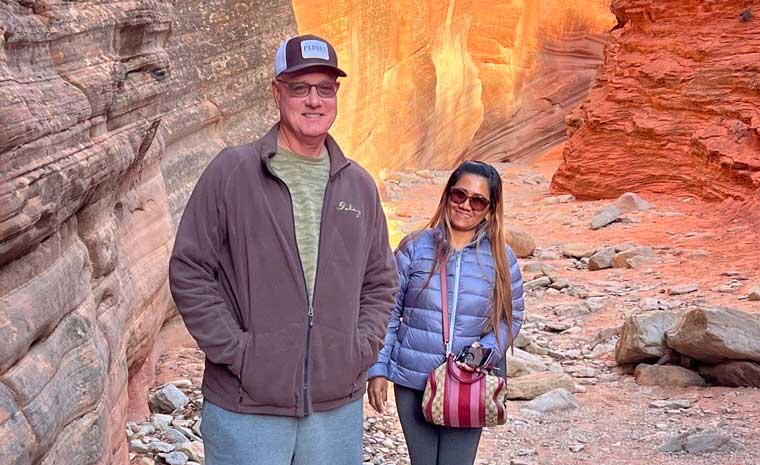
Bill Foley ('90) arrived at Embry-Riddle's Prescott Campus in 1988 as a 31-year-old freshman with a private pilot certificate, seven months of wandering through Nepal and Europe behind him, and a math test waiting that he would score a 43 on.
"So I basically started off with a triple bogey," he said.
He recovered. He always does. Foley graduated, earned his instructor ratings, spent two years back at Embry-Riddle teaching students, then built a career that carried him from commuter aircraft to the left seat of a Boeing 747-400 — international cargo routes, military missions into Bagram, and freight operations through Europe and Asia. It was the kind of flying that tested judgment as much as skill.
Today he supports Embry-Riddle golf teams through an annual scholarship, and the reason he gives it is as plain as he is.
When Foley hosted the ERAU golf team for a pizza party before watching them compete near his California home, he didn't just talk about money. He talked about the bar.
"Picture yourself as a pilot," he told them. "You show up at the hotel. You walk out. What'd you just walk by? A bar." He paused. "How many flying careers have been destroyed by alcohol? I can count a lot."
He gave them specifics — a captain he knew, a military run, a Japanese jail, two years and several million dollars in lost earnings. The message was the same one he's been using since that opening math test: keep the double and triple bogeys out of the picture. Absorb a bad hole. Don't surrender the round.
Watching the team compete that afternoon, he came away stunned.
"I was blown away how good they were," he says. "They're so mature for their age. I was nowhere near that level when I was that age."
As for the source of his generosity: Foley grew up in the orchard business, cherries on both sides of the Columbia River in Oregon. His family eventually bought Apple stock — and the coincidence was not lost on him.
"Remember in Forrest Gump — Forrest bought an apple orchard? My family also bought an apple orchard,” he recalls. “ We bought a lot of Apple stock."
Every year, he picks a few apples and puts them toward the scholarship. His annual gift of $25,000 is directed where the game is played — $10,000 to women's golf, $10,000 to men's golf, and $5,000 to golf program support. It is, he says, a commitment he intends to grow. Foley has also pledged a planned gift of $1 million to Embry-Riddle, an investment in the university that shaped everything that followed.
"They keep growing back," he says of the apples. "More every year."
He pushes fellow alumni toward the same math. Pilots at their peak are earning extraordinary salaries, he notes, with retirement contributions to match.
"This helps some people see their dreams through," he says. "Instead of sitting there watching your portfolio value, this makes some money work for somebody else."